Classification of AI Systems and Components
Executive summary and scope
Scope and assumptions. This report covers contemporary machine-learning and AI systems, including conventional predictive ML, generative AI, retrieval-augmented systems, tool-using agents, autonomous software, and safety-related cyber-physical systems. The evidence base runs through March 22, 2026 and prioritizes standards bodies, regulators, original papers, and first-party system documentation. “AI system” is treated as broader than “AI model”: the OECD describes a model as a core component used by a system to infer outputs, while the deployed system can combine one or more models with data, software, interfaces, and other components. 1
The main finding is that there is no generally accepted single-axis taxonomy for AI systems. Existing classifications answer different questions. The OECD classifies systems through People & Planet, Economic Context, Data & Input, AI Model, and Task & Output. NIST AI RMF organizes risk management around Govern, Map, Measure, and Manage and evaluates trustworthiness properties across the lifecycle. The EU AI Act primarily classifies legal risk and attaches obligations. ISO standards split architecture, lifecycle, data quality, robustness, risk management, testing, and management-system assurance across several documents. Human-factors taxonomies focus on allocation of work between people and automation, while agent research focuses on planning, action, and tool access. 2
A useful taxonomy therefore needs to be multi-dimensional. At minimum, a deployed system should be classified by:
This structure follows a recurring pattern across OECD, NIST, ISO, EU, SAE/EASA, MLPerf, and the academic literature, while filling several gaps that those sources leave when used individually. 3
Three distinctions are especially important.
First, capability and autonomy are separate properties. A highly capable model can remain purely assistive because a human must approve every consequential action. Conversely, a narrower model may be highly autonomous inside a constrained operational domain. The classic human-automation literature allocates automation at different stages of information processing, and more recent AGI classification work likewise separates performance, generality, and autonomy. SAE driving automation provides a domain-specific example in which automation level concerns who performs the driving task and under what conditions, rather than raw model accuracy. 4
Second, empirical quality, robustness, formal verification, and certification are different evidence types. Testing can show that a system behaved well on sampled cases. Formal methods can prove a specified property within a defined mathematical domain; ISO/IEC 24029-2 covers formal robustness methods for neural networks, and Reluplex is an early example of proving or refuting bounded neural-network properties. Certification can concern an organization’s management system: ISO/IEC 42006:2025, for example, specifies requirements for bodies certifying AI management systems under ISO/IEC 42001. That certification does not constitute a mathematical proof that an individual model is correct. ISO work on AI-system conformity-assessment schemes remains a separate area, including ISO/IEC DIS 42007, which is still under development. 5
Third, the system boundary is critical. Reliability of a model alone says little about a RAG application whose retriever can return stale documents, or an agent whose external API can fail, return malicious content, or perform irreversible actions. NIST explicitly calls for component-level and third-party risk management; ReAct and Toolformer show why modern systems increasingly contain reasoning/control loops and external tools as functional parts of the system. 6
The practical recommendation is therefore to classify both the whole system and each material component, then attach explicit invariants to system-component boundaries. High-value invariants include source and number provenance, complete action audit trails, version/replay information, authorization limits, approval gates, output/schema validation, latency bounds where deadlines exist, fail-safe behavior, monitoring and rollback, data-use restrictions, and explicitly bounded formal properties where verification is feasible. NIST, W3C PROV, EU requirements for logging of high-risk systems, and safety-case practice all support this evidence-centered view. 7
Evidence base and classification dimensions
The evidence falls into several complementary families. OECD gives perhaps the clearest general-purpose classification framework: People & Planet, Economic Context, Data & Input, AI Model, and Task & Output. Its goal is to connect technical characteristics with policy consequences and to support assessment of issues such as bias, explainability, and robustness. 8
NIST AI RMF is better viewed as a risk and assurance framework than a finite taxonomy. It asks organizations to define purpose, context, users, limitations, human oversight, components, third-party dependencies, metrics, safety, security, explainability, privacy, and monitoring across Govern, Map, Measure, and Manage. NIST specifically calls for evaluation of whether systems can fail safely, including reliability, robustness, real-time monitoring, and response time to failures. NIST AI RMF 1.0 is under revision as of 2026, so the synthesis here uses its published core while noting that status. 9
The EU AI Act is primarily a risk-based legal classification and obligations framework. For high-risk systems, its requirements span risk management, data and data governance, technical documentation, logging, transparency, human oversight, and accuracy, robustness, and cybersecurity. It therefore supplies many assurance dimensions, while saying much less about whether an application is batch versus streaming, monolithic versus plug-in based, or cloud versus edge. 10
ISO spreads the problem across standards. ISO/IEC 23053 provides a conceptual framework for components and functions of ML-based AI systems; ISO/IEC 5338 addresses lifecycle processes; ISO/IEC 5259 addresses data quality; ISO/IEC 24029 addresses neural-network robustness; ISO/IEC 42001 addresses organizational AI management; and the ISO/IEC 42119 series addresses testing of AI systems and components. This division is useful in practice because “classification”, “architecture”, “testing”, and “certification” are separate concerns. 11
Human-factors research adds a dimension these governance frameworks can flatten. Parasuraman, Sheridan, and Wickens classify automation according to where automation occurs in the information-processing chain: information acquisition, information analysis, decision/action selection, and action implementation. A system can therefore automate some stages while retaining human control of others. EASA makes a related distinction in aviation: Level 1 applications assist humans, while Level 2 introduces human-AI cooperation and automatic decision-making under human oversight; EASA’s proposed 2026 Issue 3 extends the framework toward advanced automation. 12
The requested dimensions can be synthesized as follows.
A source-family comparison makes the gaps clearer:
These differences are reflected in a small prevalence analysis performed for this report. The corpus contains 18 deliberately selected primary or near-primary sources spanning OECD, NIST, EU, ISO, human-automation research, SAE, EASA, Model Cards, Datasheets, W3C PROV, ReAct, Toolformer, RAG, and MLPerf. 28
A dimension was counted only when the source gave it substantive explicit treatment. An omitted dimension therefore means “not a first-class concern in this source”, not that the source considers it irrelevant. This is a purposive coding exercise rather than a systematic meta-analysis. Performance appeared in 10/18 sources, inputs/data in 9/18, autonomy and provenance in 8/18 each, while explicit runtime mode appeared in only 2/18 and edge/cloud deployment in 1/18. The tail is significant: operational architecture is much less consistently classified than model behavior, performance, and governance.
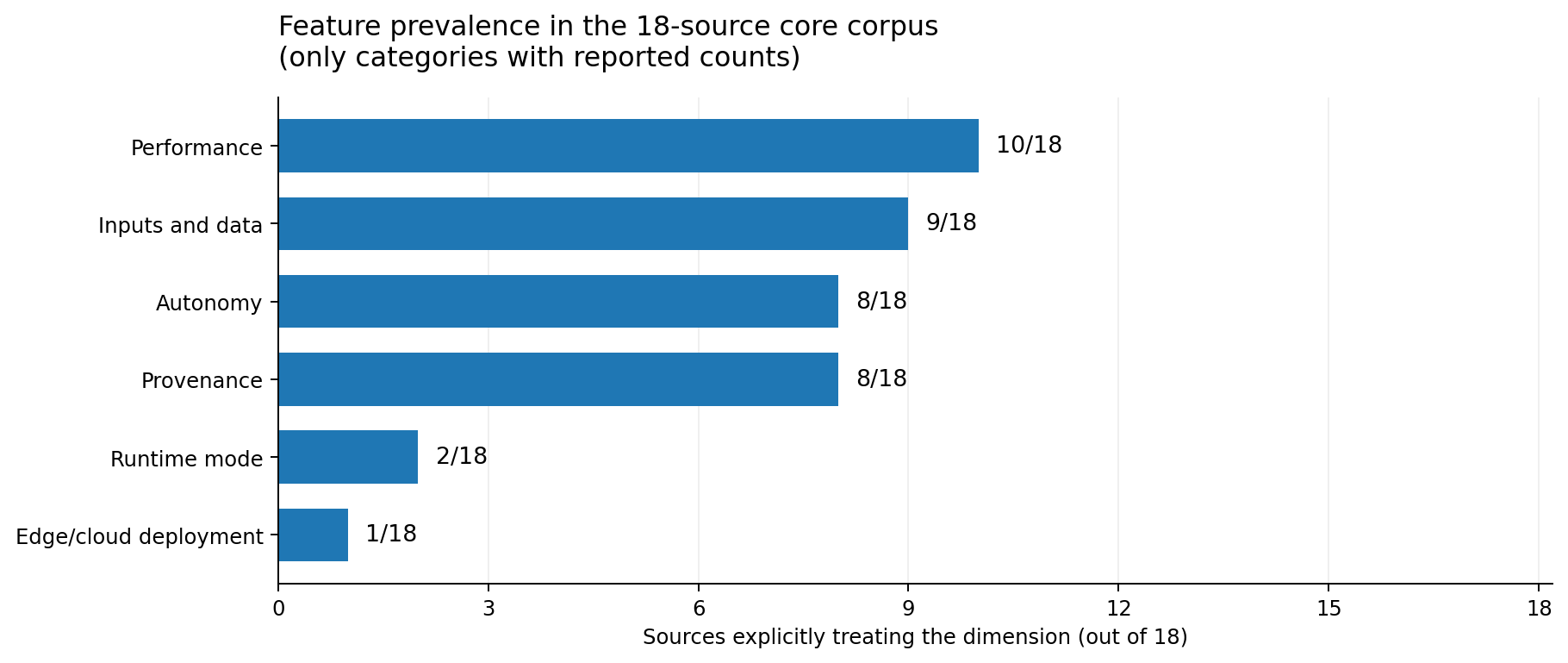
Figure recreated from the six category counts explicitly reported in the source text. The original chart image was not included in the supplied files.
The result supports a practical conclusion: a taxonomy intended for engineering use needs operational dimensions that policy and model-documentation frameworks often omit, especially runtime timing, dependency topology, privileges, and deployment location. Conversely, an engineering architecture taxonomy needs governance and human-impact dimensions that software diagrams often omit. 29
Component taxonomy and architecture
A component taxonomy should classify components by function, then attach cross-cutting attributes such as learned versus deterministic, stateful versus stateless, internal versus third-party, privileged versus unprivileged, and safety-critical versus supporting. ISO/IEC 23053 establishes the general principle that ML systems consist of identifiable components and functions with interactions, while NIST explicitly asks organizations to map component and third-party risks instead of treating the model as the whole system. 30
The following functional decomposition works across traditional ML applications and modern agentic systems.
RAG is a useful illustration of why this decomposition matters. The original RAG architecture separates a parametric generator from non-parametric memory accessed through a neural retriever. The paper explicitly motivates the design partly because provenance and updating knowledge are hard when knowledge exists only in model parameters. A deployed RAG service therefore has at least a generator, retriever, corpus/index, ingestion pipeline, and usually a citation or provenance layer; testing only the generator misses several primary failure modes. 31
Agent architectures make the controller and connector categories more important. ReAct interleaves reasoning and task-specific actions and uses those actions to interact with external knowledge bases or environments. Toolformer learns which APIs to call, when to call them, and what arguments to send. A tool-using model therefore introduces a new classification question that does not arise for a static classifier: what effects are reachable through the tool graph? 32
The same distinction is visible in deployed products. GitHub Copilot can use MCP servers to access repository and third-party context; GitHub documents toolsets as independently configurable and recommends enabling only necessary capability groups because tool availability affects both accuracy and security. Microsoft Copilot Cowork executes multi-step work across email, calendars, documents, Teams, research, and files, with sensitive actions gated by approval. The model is therefore one component inside a controller/tool/authorization/UI system. 33
Verifiers require a further distinction. A deterministic schema check can guarantee that a syntactically invalid action is rejected. A formal neural-network verifier can establish a mathematical property in a specified region; Reluplex, for example, was designed to verify neural-network properties or produce counterexamples. A learned “judge” or safety classifier supplies probabilistic evidence and can itself fail. These components should all be called verifiers only if their assurance type is recorded explicitly. 34
The following entity-relationship diagram captures a general system decomposition. It is a synthesis rather than a diagram prescribed by any single standard; its separation of models from the containing system follows OECD and ISO usage, and its component and dependency boundaries follow NIST and modern agent/RAG architectures. 35
    erDiagram
    AI_SYSTEM ||--o{ COMPONENT : contains
    AI_SYSTEM ||--o{ HUMAN_ACTOR : involves
    AI_SYSTEM ||--|| RUNTIME : deployed_on

    COMPONENT }o--o{ DATA_ASSET : consumes_or_produces
    COMPONENT }o--o{ AUDIT_RECORD : generates

    CONTROLLER ||--o{ MODEL : invokes
    CONTROLLER ||--o{ RETRIEVER : queries
    CONTROLLER ||--o{ CONNECTOR : calls
    CONTROLLER ||--o{ VERIFIER : requests_checks

    RETRIEVER }o--o{ DATA_ASSET : retrieves_from
    CONNECTOR }o--|| EXTERNAL_SYSTEM : accesses
    VERIFIER }o--o{ COMPONENT : checks
    MONITOR }o--o{ COMPONENT : observes
    UI }o--o{ HUMAN_ACTOR : mediates
    AUDIT_STORE ||--o{ AUDIT_RECORD : stores
    RUNTIME ||--o{ COMPONENT : hosts

    AI_SYSTEM {
        string purpose
        string consequence_class
        string action_authority
        string timing_class
    }

    COMPONENT {
        string component_type
        string version
        string owner
        string trust_boundary
        string assurance_type
    }

    MODEL {
        string model_family
        string input_modality
        string output_type
        string adaptation_mode
    }

    CONTROLLER {
        string policy
        string state_mode
        string action_scope
    }

    CONNECTOR {
        string privilege
        string authentication
        string side_effect_class
    }

    VERIFIER {
        string property_checked
        string evidence_type
        string failure_policy
    }

    HUMAN_ACTOR {
        string role
        string approval_authority
        string override_authority
    }

    DATA_ASSET {
        string sensitivity
        string provenance
        string version
    }
Two component properties deserve explicit treatment because they propagate upward.
Trust boundary. Internal code, a third-party hosted model, retrieved web content, an enterprise database, and an actuator should not inherit one another’s trust assumptions. NIST explicitly directs organizations to track pretrained and third-party components throughout risk management. 36
Privilege and side effects. A read-only search connector and a connector that can send messages, transfer money, modify source code, or command a machine are categorically different even when the same model calls them. Current agent products already reflect this distinction by placing approval gates around sensitive actions and using scoped tool credentials. 37
Invariants and assurance requirements
“Invariant” is used loosely in AI discussions, so four evidence categories should be separated.
A hard runtime invariant is enforced on every execution within its technical assumptions: for example, “this agent token cannot invoke the payment API” or “an output that fails the JSON schema is never forwarded.” A bounded formal guarantee proves a mathematical property in a specified domain, such as local robustness within a perturbation region. An operational requirement establishes a measurable bound such as a latency SLO or availability objective. An assurance claim is supported by accumulated evidence such as testing, process controls, independent validation, regulatory review, or a safety case. Formal neural-network verification and Waymo’s safety-case methodology illustrate why these evidence forms should not be conflated. 38
Common invariants and guarantees map to systems as follows.
The correct invariant set depends strongly on system class.
A batch analytical or scientific model usually needs reproducibility, model/data lineage, declared metric thresholds, controlled changes, and enough provenance to recreate an analysis. Exact latency guarantees may be irrelevant. Model Cards and Datasheets directly support this class. 42
An interactive assistant adds response-time requirements, privacy controls, user-facing limitations, traceability to sources where factual grounding is expected, and a clear distinction between suggestions and actions. Human review can carry much of the decision authority when outputs remain proposals. 51
A high-stakes decision-support system should add explicit intended-use boundaries, independent validation, performance by relevant subgroups, uncertainty/calibration where meaningful, audit logs, human authority, appeal/correction mechanisms, and controlled changes. The EU high-risk controls, NIST RMF, Model Cards, and regulated medical-device practice converge on many of these requirements. 52
A RAG or evidence-grounded generator needs a different set of invariants: retrieval corpus/version, source identity, access rights, freshness policy, exact retrieved evidence, and a trace from generated factual claims or numbers to supporting evidence when that property is required. The original RAG paper’s explicit motivation around knowledge updating and provenance makes this architectural difference clear. 31
A tool-using agent needs capability boundaries, authentication and authorization, approval policies, complete action logs, time and cost budgets, tool-result validation, termination criteria, and rollback/idempotency where actions can modify external state. Toolformer and ReAct establish external API/environment access as part of the computation; current NIST agent work focuses on secure and interoperable agent behavior, and deployed products already use explicit approval gates. 53
An autonomous physical system further requires an operational domain, timing guarantees, sensing and actuator health assumptions, safe-state behavior, extensive validation, continuous monitoring, and a structured safety argument. Waymo’s safety case explicitly combines system description, development methodology, validation metrics, and validation results to justify deployment without a human driver. 54
One important engineering conclusion follows: invariants belong at interfaces as often as they belong to models. For an agent, “tool arguments satisfy policy before execution” is frequently more enforceable than “the LLM will never propose a dangerous action.” For RAG, “every displayed citation resolves to a retrieved source used for that response” is more testable than a broad requirement that the model “never hallucinate.” This follows from the distinction between probabilistic learned components and enforceable deterministic system boundaries reflected in NIST’s component approach and formal verification work. 55
Comparative system taxonomy
The table below applies the dimensions to representative system types. “Unspecified” means that the cited public source does not make the dimension clear enough to classify confidently; it should not be read as an assertion about the internal implementation.
Several cross-cutting patterns emerge.
Autonomy rises primarily when outputs become externally effective actions. Generating an answer, prediction, draft, or code suggestion is usually assistive. Creating a pull request is a bounded external action. Sending email or modifying shared files carries broader organizational side effects. Steering a vehicle creates immediate physical effects. That gradient is better represented through action authority and operational boundaries than through a single “AI sophistication” score. 63
Human oversight changes form with timing. Pre-action approval works for an email agent because seconds of delay are acceptable. It cannot be the primary safety mechanism for every steering decision in an autonomous vehicle. Safety-related real-time systems therefore shift assurance toward prevalidated operational bounds, monitors, safety controllers, and safe failure. NIST’s explicit treatment of response time and safe failure and the SAE/Waymo frameworks support this distinction. 64
Deployment location is an independent feature. A cloud-hosted model can serve an assistive or autonomous application; an edge model can likewise be advisory or safety-critical. Edge deployment mainly changes resource, connectivity, update, latency, privacy, and availability requirements. MLPerf’s separate datacenter, edge, mobile, and tiny benchmarks illustrate this independent dimension. 25
Modularity is both an architectural benefit and an assurance burden. Components can be evaluated and replaced independently, but every component boundary creates dependency and versioning questions. A RAG system can update its corpus independently of its model; an agent can add a new tool without changing model weights; either change can substantially alter system behavior. NIST’s third-party/component monitoring guidance is therefore directly relevant to modular architectures. 65
Practical classification framework
For new systems, a useful classification record should contain nine fields. These are a synthesis of the evidence above; they are not claimed to be an OECD, NIST, ISO, SAE, or EU standard.
The proposed action-authority classes deserve emphasis. They should not be treated as another universal “levels of AI” standard and they do not map one-to-one onto SAE driving levels. Their purpose is to give software architecture reviews an immediate answer to a practical question: what can this system cause to happen without a new human decision? The importance of that question follows from human-automation research, EASA’s distinction between assistance and automatic decision-making under oversight, and current agent standards work. 66
The most useful decision rules are:
The decision process can be operationalized as follows:
    flowchart TD
    S[Define intended use, users, environment and failure consequences]
    S --> Q1{Can the system cause an external side effect?}

    Q1 -- No --> A1[Classify as information, prediction, recommendation or draft]
    Q1 -- Yes --> Q2{Is human approval required before the material action?}

    Q2 -- Yes --> A2[Classify proposed-action authority and record approval gate]
    Q2 -- No --> Q3{Is automatic action limited to a declared domain and policy?}

    Q3 -- Yes --> A3[Classify bounded autonomous execution]
    Q3 -- No --> A4[Classify broad autonomous execution and require explicit risk review]

    A1 --> Q4
    A2 --> Q4
    A3 --> Q4
    A4 --> Q4

    Q4{High consequence, rights-affecting, regulated or safety-related?}
    Q4 -- Yes --> R1[Escalate assurance: independent validation, oversight, logs, fail-safe and sector requirements]
    Q4 -- No --> D1[Apply baseline assurance]

    R1 --> Q5
    D1 --> Q5

    Q5{Deadline-constrained or physical real-time operation?}
    Q5 -- Yes --> T1[Specify latency/deadline, operational domain, safe-state and monitoring]
    Q5 -- No --> T2[Specify batch, async or interactive SLOs]

    T1 --> Q6
    T2 --> Q6

    Q6{External model, retriever, API, tool or actuator?}
    Q6 -- Yes --> X1[Map dependency, privilege, trust boundary, version, fallback and audit]
    Q6 -- No --> X2[Record internal component graph]

    X1 --> Q7
    X2 --> Q7

    Q7{Sensitive or governed data?}
    Q7 -- Yes --> G1[Specify lineage, purpose, access, privacy, retention and deletion]
    Q7 -- No --> G2[Specify ordinary data lineage and quality]

    G1 --> Q8
    G2 --> Q8

    Q8{Requires factual, numerical or reproducible evidence?}
    Q8 -- Yes --> P1[Require source/number provenance and replay/version evidence]
    Q8 -- No --> P2[Document normal traceability]

    P1 --> F[Produce system classification plus component classifications and invariant register]
    P2 --> F
The resulting record should be reviewed per component as well as per system. A practical component checklist is:
- What is this component’s function and version?
- Is it learned, deterministic, or a mixture?
- Is it stateful? Can state survive requests?
- What data can it read?
- What external state can it modify?
- Which credentials and privileges does it hold?
- Is it first-party, third-party, or dynamically discovered?
- What happens when it fails, times out, or returns malformed content?
- Which invariant is enforced here, and is that enforcement deterministic, statistical, operational, or formally verified?
- What telemetry proves the component behaved as expected?
- Can it be rolled back or replaced independently?
- What system-level evidence becomes invalid when it changes?
This approach is consistent with ISO’s component view and NIST’s instruction to track risks of connected components and pretrained/third-party models throughout their lifecycle. 30
A compact system descriptor can consequently look like:
Customer-support RAG agent: medium-consequence enterprise system; A2 action authority; text/document input including personal data; interactive cloud deployment; LLM + retriever + enterprise corpus + controller + ticketing connector + policy verifier + audit store; pre-action approval for refunds/account changes; p95 response SLO; document/citation provenance; connector-level authorization; privacy/retention controls; empirical model/retrieval evaluations plus production monitoring.
That descriptor conveys substantially more engineering information than labels such as “LLM application”, “agentic AI”, or “human in the loop”, because it identifies the actual authority, data, timing, dependencies, controls, and evidence.
Findings, limitations, and implications
The research supports several general conclusions.
AI system classification works best as a vector, not a hierarchy. OECD’s five dimensions, NIST’s lifecycle controls, human-automation levels, performance benchmarks, and architecture papers each expose information that cannot be reconstructed from a single “risk level” or “autonomy level.” In particular, performance, generality, autonomy, consequence, and deployment constraints are logically independent. 71
Autonomy should be classified at the action boundary. Whether the underlying technology is an LLM, vision network, symbolic planner, or hybrid is less informative for operational risk than whether it can execute consequential actions and under whose authority. NIST’s 2026 agent initiative explicitly centers agents capable of autonomous actions, while deployed Cowork and GitHub systems expose action scope and approvals as concrete controls. 72
“Human in the loop” is too coarse for serious system documentation. Human roles can include request, review, pre-action approval, continuous supervision, emergency override, post-hoc audit, and appeal. The feasible role also depends on timing: manual approval may be appropriate for enterprise transactions yet impossible as the primary mechanism in millisecond-scale physical control. Human-automation research, EASA, NIST, and autonomous-driving classifications all reinforce this point. 73
Provenance and explainability solve different problems. Provenance answers questions such as “which source, data, model version, activity and actor led here?” W3C PROV provides explicit structures for that chain. Explainability concerns how a system arrived at or represents a decision mechanism, while interpretability concerns what the result means in context under NIST terminology. A system can have excellent provenance and weak mechanistic explainability, or the reverse. 74
Verifiability must name the property being verified. “Verified AI” without a property and domain is not a useful classification. Formal methods can establish properties such as bounded local robustness for certain networks; they do not thereby prove factual correctness, fairness, security, safe tool use, or correctness of the surrounding system. ISO/IEC 24029-2 and Reluplex make the scope of formal robustness verification explicit. 48
Certification must name the object of certification. ISO/IEC 42006 concerns bodies that audit and certify organizations’ AI management systems according to ISO/IEC 42001. It is therefore evidence concerning management-system conformity. ISO work specifically directed at AI-system conformity-assessment schemes is separate and, as of March 2026, includes work still under development. 75
Runtime and deployment characteristics are underrepresented in general AI taxonomies. The prevalence coding in this report found only 2 of 18 sources making runtime mode a substantive feature and only one making edge/cloud deployment explicit at the classification level. MLPerf shows that these distinctions materially change what should be measured: Offline workloads optimize throughput, Single-Stream workloads expose latency, Tiny adds resource and optional energy concerns, and datacenter and edge systems are benchmarked separately. 76
Modern agentic systems make component classification more important. Once a model can select tools, retrieve external content, maintain state, and perform actions, overall behavior depends on controller logic, authorization, connectors, external service behavior, and human approval policies. ReAct and Toolformer establish the architectural pattern in the research literature; NIST’s agent initiative and current Microsoft/GitHub implementations demonstrate its operational relevance. 77
The most dependable guarantees are often enforced outside the generative model. Authorization checks, schemas, transaction limits, tool allowlists, approval gates, provenance logging, runtime budgets, and fail-safe transitions can be engineered as deterministic controls even when the model generating a proposal is probabilistic. Formal neural-network methods can add stronger bounded claims where suitable; safety cases and lifecycle controls address broader system claims that cannot generally be reduced to a model proof. 78
Finally, the framework should preserve “unspecified” as a valid value. Missing information is itself important. Public documentation may describe model performance while omitting deployment topology; a regulatory authorization may describe intended use without disclosing internal architecture; an agent paper may specify its controller loop while saying little about privacy or operational auditability. Filling such fields by assumption would make the taxonomy less useful. Model Cards and Datasheets were created in part because systematic documentation of intended use, evaluation, data origin, and limitations cannot safely be inferred from the artifact alone. 42
The resulting practical rule is:
Classify what the system is allowed to do, what it observes, where and when it operates, who retains authority, which components and dependencies determine its behavior, and exactly what evidence supports each promised property. Then classify each material component with the same discipline. That formulation combines the strongest parts of the OECD system view, NIST lifecycle risk management, ISO component and assurance standards, human-automation taxonomies, formal verification research, provenance standards, and operational benchmark practice. 79
Source references
Library sources
- Sapkota et al. 2026, AI Agents vs. Agentic AI (doi:10.1016/j.inffus.2025.103599)
- shown 2025, Evaluating and Regulating Agentic AI
- Anderson et al. 2026, The agenda game (doi:10.1007/s44382-026-00026-3)
- Russell 2019, Human Compatible: Artificial Intelligence and the Problem of Control
- Amou Najafabadi et al. 2024, An Analysis of MLOps Architectures: A Systematic Mapping Study (arXiv:2406.19847)
- Sens et al. 2025, A Large-Scale Study of Model Integration in ML-Enabled Software Systems (arXiv:2408.06226)
What is AI? Can you make a clear distinction between AI … ↩︎
The OECD Framework for Classifying AI Systems to assess … ↩︎
The OECD Framework for Classifying AI Systems to assess … ↩︎
ISO/IEC 24029-2:2023 - Robustness of neural networks – Part 2 ↩︎
The OECD Framework for Classifying AI Systems to assess … ↩︎
Regulation - EU - 2024/1689 - EN - EUR-Lex - European Union ↩︎
ReAct: Synergizing Reasoning and Acting in Language Models ↩︎
The OECD Framework for Classifying AI Systems to assess … ↩︎
Trustworthy AI: Managing the Risks of Artificial Intelligence ↩︎
Toolformer: Language Models Can Teach Themselves to Use Tools ↩︎
The OECD Framework for Classifying AI Systems to assess … ↩︎
The OECD Framework for Classifying AI Systems to assess … ↩︎
The OECD Framework for Classifying AI Systems to assess … ↩︎
Retrieval-Augmented Generation for Knowledge-Intensive NLP Tasks (PDF) ↩︎ ↩︎ ↩︎
ReAct: Synergizing Reasoning and Acting in Language Models ↩︎ ↩︎
An Efficient SMT Solver for Verifying Deep Neural Networks ↩︎
What is AI? Can you make a clear distinction between AI … ↩︎
An Efficient SMT Solver for Verifying Deep Neural Networks ↩︎
Regulation - EU - 2024/1689 - EN - EUR-Lex - European Union ↩︎
ISO/IEC 24029-2:2023 - Robustness of neural networks – Part 2 ↩︎ ↩︎
AI Risks and Trustworthiness - AIRC - NIST AI Resource Center ↩︎ ↩︎
Regulation - EU - 2024/1689 - EN - EUR-Lex - European Union ↩︎
Toolformer: Language Models Can Teach Themselves to Use Tools ↩︎
EASA Artificial Intelligence concept paper (proposed Issue 2 … ↩︎
10 AI Lessons from Driving 200+ Million Fully Autonomous … ↩︎
Retrieval-Augmented Generation for Knowledge-Intensive NLP Tasks ↩︎
The OECD Framework for Classifying AI Systems to assess … ↩︎
ReAct: Synergizing Reasoning and Acting in Language Models ↩︎
The OECD Framework for Classifying AI Systems to assess … ↩︎